I can't talk about floods in Sao Paulo without giving you an explanation for why it happens and why it is so violent.
You will read many newspapers and many blogs of people who are not from Sao Paulo blaming the issue of floods on politicians or perhaps gutters clogged with trash.
If you live in Sao Paulo you know the city is pretty clean for a big city and you most likely have never seen this much rain coming down at once.
Recent governments have built gigantic "Concrete Boxes" under the city that collect the extra amount of water and prevent floods in certain areas, these flood containment devices are called "Piscinoes" or "Big Swimming Pools". The most notorious was built under the parking lot of Pacaembu Soccer stadium and helped reduce the flooding around the Sumare Avenue in the Perdizes and Pacaembu areas of Sao Paulo.
My personal opinion is based on observation and facts. It is just TOO MUCH WATER, PERIOD.
So we need to learn how to deal with it and we can do just fine.
São Paulo has a highland subtropical climate (
Cwb), according to the Koppen classification.
In summer, temperatures are between 17 °C (63 °F) and 28 °C (82 °F), and 32 °C (90 °F) on the HOTTEST DAYS. In winter, are between 11 °C (52 °F) and 23 °C (73 °F), and 6 °C (43 °F). on the coldest days.
The highest temperature recorded was 35.3 °C (95.5 °F) November 15, 1985
and the lowest recorded was −2 °C (28.4 °F) on August 2, 1955, and on the same day was recorded −3.8 °C (25 °F) unofficially.
The
Tropic of Capricorn, at about 23°27' S, passes just north of São Paulo and roughly marks the boundary between the tropical and temperate climates. Because of its elevation, however, São Paulo enjoys a more agreeable climate in comparison to most parts of the Brazil.
The abundant rainfall is responsible for the annual and infamous flooding in the prone areas of the city, amounting to an annual average of 1,454 millimetres (57.2 in) of rain.
It is especially common in the warmer days of the summertime averaging 219 millimetres (8.6 in), and decreasing in winter when the average is 47 millimetres (1.9 in).
Neither São Paulo nor the nearby coast has ever been hit by hurricanes and tornadoes are rather uncommon.
Snow flurries were reported officially only once, on June 25, 1918. During late winter, especially August, the city experiences the phenomenon known as
"veranico" (Little summer), which consists of a bout of unusually hot and dry weather, sometimes reaching temperatures well above 28 °C (82 °F). On the other hand, relatively cool days during summer are also fairly common when persistent winds blow from the ocean. On such occasions daily high temperatures may not surpass 20 °C (68 °F), accompanied by lows often below 15 °C (59 °F).
Long story short, Sao Paulo has very mild and pleasant climate for the most part of the year.
It has always rained in the summer, A LOT, and floods are a part of the environment, much before the city was where it is, too many rivers big small cross the area in every direction. Today, many of them have been paved and cover by roads.
Water springs usually break the asphalt in Sao Paulo all around the city and crystal clear clean water comes out in abundance.
Many high rises built underground pumps that constantly pump out clear spring water on to the city gutters.
If you ever see clean water running on the gutters on a sunny dry day, you have spotted a water Spring area nearby.
HERE is a link with this afternoon's news in Portuguese and a lot of pictures from this today's flooding event in Sao Paulo.
Translating the headline "Rain in Sao Paulo overflowed streams, closes Airport, interrupts train service and blocks highway"...
When I read this headline, I filter it inside my head and break it up in many levels, being from Sao Paulo, news of flooding are not really news, it's same sh..., different day, sort of like Wild Fires in Los Angeles, Hurricanes in Florida, or Tornadoes in Texas and Oklahoma, it's a given:
First: "Airport closed", ok, no big deal, read
THIS and you will understand why they close Congonhas Airport during strong rain storms in the city. I can't blame them, if you know the facts, nobody wants to be blamed for another one of these disasters. After all, they only close the Airport during the rain, which is only between 30 minutes and a couple of hours tops.
Second: "Overflowed streams"!! Yeah! You cut all the forests around the stream, built a city all around it, covering all the ground with asphalt, concrete and glass buildings, where do you expect all that water to go?
Have you ever shaken a small tree after a rain? You know how much water is retained on leaves and how much water sips into the ground right?
Now, imagine no vegetation to hold any water anywhere and no ground for the water to sip in, the water goes all to the streams, naturally they flood every time.
Third: "Interrupts train service", If you live in Sao Paulo you know that many train lines were built right next to the rivers, on the flood plains, what do you expect? Train service interrupted during heavy flooding? Yes! Too obvious right! When you drive along "Marginal Pinheiros" you can see train stations and trains running along the river.
The name "Marginal" means margin, so it means these highways run along the margin of the river.
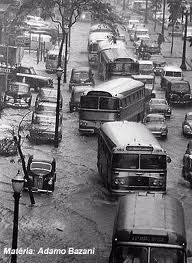
What you should know is that the places that are flooding today in Sao Paulo, have always flooded, the exact same streets, the exact same intersections, most local folks know to avoid these areas and certain situations.
 |
| Flooding in the outskirts of the city of Sao Paulo 50 years ago! |
 |
| Flooding downtown Sao Paulo in the 1940's |
 |
| Downtown Sao Paulo flooded in the early 1940's |
 |
| Sao Paulo flooded streets during the 1950's |
See, nothing new, it has always happened.
So, when I started to venture out into the city as a young adult, my parents and grandparents always alerted me to the Avenues and streets to stay away from when it started to rain during summer months.
If you are familiar with the city's topography, avoid all lower areas during heavy summer rain storms.
The storms always, always happen at the end of the afternoon, usually between 3 and 5 pm. You can literally see the day turn into night in the middle of the afternoon, city lights will turn on and it will feel like midnight, the BLACK clouds are heavy and scary as hell.
So, the smart thing to do is to always avoid being out and about at the end of the afternoons during the summer, principally if it has already rained for a couple days in roll, that is when floods usually happen. The soil is already too saturated and floods are inevitable.
I always had a plan B in case it rained bad and I knew the floods had began.
It is just plain stupid to think you can beat the rush hour crowd and get home before it gets bad, just for the simple fact that EVERYONE will think like you.
You will be stuck in traffic and if you don't know the streets well enough, you might just end in the middle of a huge mess.
 |
| This could be you if you try to beat the rush hour crowd. |
 |
| Folks trying to beat the rush hour traffic during floods in Sao Paulo |
Come on, be smart, have a plan B.
Like I always did. Have your favorite music CD's in your car in case you get stuck in traffic. Make sure you always have your cell phone charger in the car with you. Have some snacks and drinks too, why not? You wanna be stuck in traffic in the most possible comfort.
As a typical Paulistano, I could be stuck in traffic a whole week inside my car and I would be just fine ;)
But I am an expert in escaping big city traffic, so that would never happen to me! HA!
Your plan B could be anything, it is obviously customized to your lifestyle and your leisure preferences.
If I peaked outside my window and it looked like the picture below:
 |
| Sao Paulo summer storm, corner of Faria Lima and Cidade Jardim Avenues |
Don't get out if you can and if you are already outside, find a place to be for a couple of hours.
I usually would go into a Mall, park my car safely above ground, look for a good movie to watch at one of the Mall's many cinema's or do some shopping, this is the best time to go sale hunting, you are stuck at the Mall with no place to go.
Gil and I would sometimes during floods, find a nice Coffee shop and spend hours sipping Lattes, eating Cheese Bread and talking ourselves to death.
Sometimes I would just stay in the office and do some work. You can always make yourself productive by working overtime hours.
If you are driving around a low area close to a river, don't wait for the traffic to get bad.
Take the first cross street and get the hell out Dodge, look for alternative routes. Drive to higher ground immediately, don't wait until you see water flooded streets to make your move.
NEVER EVER DRIVE INTO AN UNDERGROUND TUNNEL DURING FLOODING IN SAO PAULO, many people have drowned doing just that...
 |
| This tunnel under Ibirapuera Park always floods during strong storms. The pumps just can't handle the flash flood. |
I was visiting my family in Sao Paulo two summers ago and my brother and his wife wanted to take me to this new exotic Pizza place called Santa Pizza, at Vila Madalena neighborhood, it is a very eclectic and trendy little Pizza place.
I literally gagged when I saw some of the Pizzas in their menu, Brie, Banana and Curry!
Come on!
There should seriously be jail time for people who come up with such aberrations!
Ok, side tracking alert, that's a discussion for another post.
It had been raining hard for several days, so I told my brother, you know Vila Madalena, it is an area with very steep hills, some streets are inclined on a ridiculous angle, let's park somewhere OFF the street, into a parking garage or something.
Santa Pizza is almost at the bottom of a Harmonia Street, which is a very steep street with a paved over stream at the bottom of it.
What happens in violent storms in Sao Paulo is that some of these very steep streets become fierce rivers with powerful waters of incredible force.
These powerful instant water falls drag everything in it's way downstream.
So, while we were calmly eating our Pizza, ( ESCAROLE Pizza, don't worry, I am still sane) all hell was breaking loose outside, a powerful river had formed right outside the restaurant and it literally swept all cars parked on the street downhill towards the small underground stream.
There are huge drains at the bottom of Harmonia street for water drainage.
This events are usually very fast, it is FLASH FLOODING at it's best.
During the time we ate a Pizza, a river formed outside, it swept about 15 cars down the street and piled them up on top of each other like toys.
Within the period of one hour, the rain had stopped and the water was gone, all we saw when we walked outside was a pile of cars at the end of the street. It was surreal, we were completely oblivious to the outside chaos.
My brother thanked me for reminding him to park inside the parking garage. We drove safely home.
The scene outside Santa Pizza that evening looked something like the picture below but much worse, with a lot more cars piled on top of each other:
 |
| Yep, it happens during every strong rain in Sao Paulo |
 |
| Come on people, you can't be that distracted!!! |
So, Stay alert! Principally if it has been raining for several days in a roll. The soil will be saturated, there is nowhere for the water to go, flash flood is a given.
It is almost an exact science. Too much water, nothing to hold the water back, bad combination.
Another simple example:
I went to Alphaville with a friend on my last visit to Sao Paulo, she works for a TV station and was filming a show in that area for the afternoon.
If you know Sao Paulo, you must know that Alphaville is just outside of the city, you take Castelo Branco Highway to get into Sao Paulo.
As we start to drive back into Sao Paulo I see the BLACK clouds and immediately suggest we find a restaurant in higher ground and wait for the storm and the flood to pass.
I started playing with her SUV's navigation system and found a Japanese Sushi Place at Lapa neighborhood, which is NOT a typical area for restaurants in Sao Paulo, but it was on high ground and it was SUSHI!
Lapa has a large middle residential area in the hills and industries and warehouses near the Marginal do Tiete Highway, where it usually floods.
We had a great SUSHI dinner while the world fell apart outside.
Loud thunder, fierce rain, cars, trucks and buses were stuck on flooded highways, streets and avenues, airport closed, train service interrupted, the end of normal life as we know it, well, at least for about 40 minutes or so.
Folks, it isnt' hard, you just have to be a little alert about it. Have a plan B.
Get into a Mall, restaurant, Movie Theater, Grocery Store, whatever, find something to do with your time instead of sitting in the car and thinking you can win over mother nature. You just can't.
By doing this you will always keep yourself safe and sane, making the best use of your time.
HIGH RISK areas for flooding to avoid in Sao Paulo:
1- Tunnel Vale do Anhangabau-Downtown - This is the most dangerous area in my opinion, avoid it at all costs. There is an underground stream under the tunnel, it usually fills up completely during floods.
HERE you can see a flash flood at Avenida 9 de Julho that leads to Tunnel Vale do Anhangabau in a recent flood, it's a 50 second video, but it will give you an idea of what happens in these dangerous areas to avoid during strong rains.
Take any of the several higher ground alternatives in the surrounding area. You can also take cover into safe, higher ground inside
beautiful Shopping Light ( Mall ) .
2- Avoid any tunnel around the city that goes underground, under rivers, streets or avenues. The pumps can't handle the quick rush of water at the peak of the storms and the tunnels have dangerous flash floods.
3- Avoid any street, avenue or highway next to a river or small stream. They don't usually flood completely but the few spots where they flood are enough to create monster traffic jams.
Notable highways to avoid: All Marginais; Marginal Pinheiros ( Pinheiros River ), Marginal Tiete ( Tiete River), Avenida dos Estados ( Tamanduatei River ), Avenida Aguas Espraiadas ( Aguas Espraiadas stream ), Avenida Luis Carlos Berrini ( There is a small stream under this avenue that usually floods ), just to name a few.
4-Avoid Avenida 9 de Julho near downtown, north of Paulista Avenue tunnel. Strong currents usually develop on that section of the avenue and they will drag your car down stream towards downtown, if you are caught in it, take any cross street on both sides to higher ground, the link to the video on the #1 item shows Avenida 9 de Julho with flooded cars, buses and a motorcycle biker clinging for dear life.
5-Via Anchieta Highway occasionally floods right on the border between Sao Paulo and Sao Bernardo do Campo, right in front of UNIBAN University ( The former Ford Brasil Headquarters ). There is a small river that floods right at the city line.
If you have to drive to the coast under heavy rain, take IMIGRANTES Highway, it is newer, safer and it never floods on any point, traffic always flows much better thru Imigrantes anyway.
6-Avoid Avenida Ricardo Jafet at Ipiranga neighborhood in the ZONA SUL area. There is a small river in the middle of the avenue that floods often. Take any cross street to higher ground or drive into Carrefour Supermarket or Plaza Sul Mall where you will find above ground safe parking.
Follow these easy steps, be alert during strong rain storms and you should be just fine.
There is no excuse for falling victim to these kinds of traps if you follow basic these basic tips.
Now, enjoy Sao Paulo's great weather, keep in mind that you don't have harsh winters, extremely hot summers, Earthquakes, Hurricanes, or Tornadoes to threaten your peace and quiet.
Sao Paulo is a big city... no, it's a humongous city.
But if you just use of some
common sense and set your mind to deal with what comes along, you certainly will be able to make a piece of paradise there like we have been doing ourselves.
We are looking forward to joining you soon!
;)
Ray